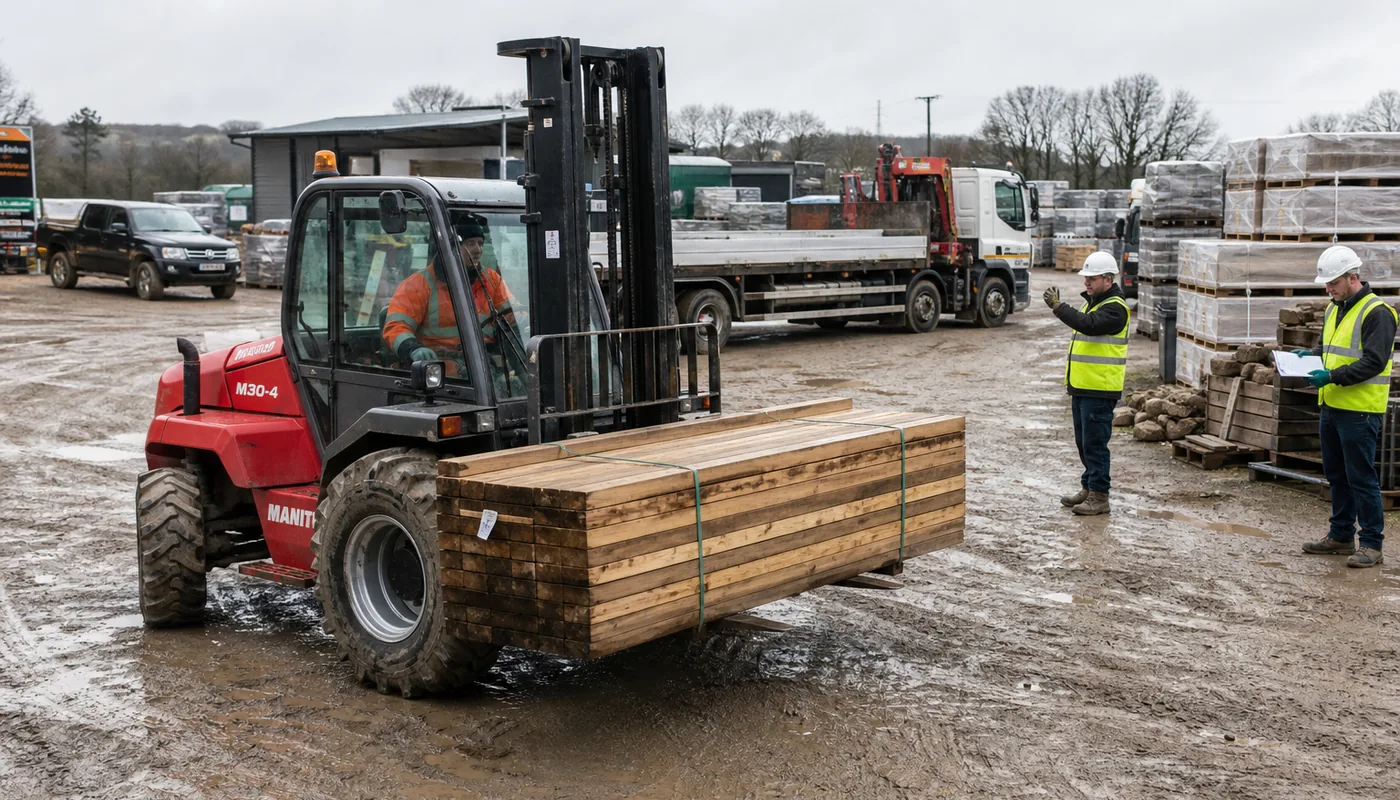
An outdoor forklift has to do more than survive dirt. It needs enough traction to move, enough clearance to avoid hanging up, a stable route for the load and a mast that fits the work. Buyers sometimes pay for a rough-terrain label when a pneumatic-tire industrial truck would do, or undersize a machine because the yard looked firm during a dry inspection.
Compare dedicated rough terrain forklifts for sale with standard pneumatic-tire forklifts and telehandlers before choosing the machine class.
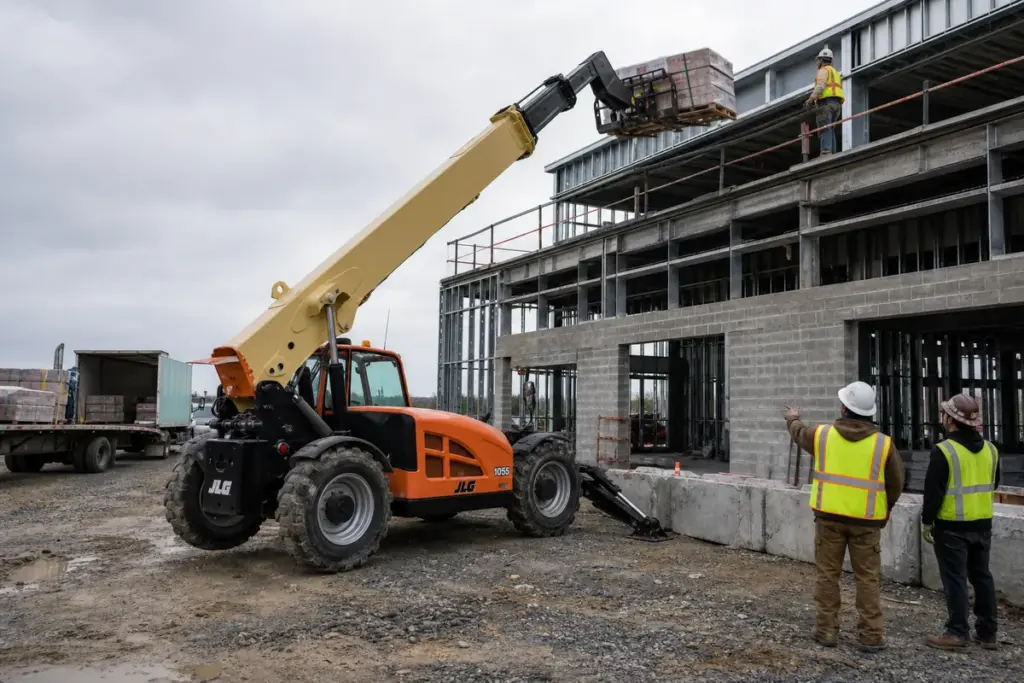
JCB 930-class and Manitou M30-4-style vertical-mast rough-terrain forklifts are familiar in yards, agriculture and construction supply. Telehandlers add forward reach and elevated placement but are larger, more complex and priced differently. A pneumatic-tire industrial forklift may be the economical answer on compacted yards with limited rough travel.
| Model or category | Good starting application | What to verify |
|---|---|---|
| Vertical-mast rough-terrain forklift | Yards and sites needing conventional fork handling on irregular ground | Traction, clearance, mast, gradeability and turn space |
| Telehandler | Jobs requiring forward reach or elevated placement | Load chart, boom, stabilizers, attachments and transport |
| Pneumatic-tire industrial forklift | Compacted yards and mixed dock work | Surface condition, tire type, clearance and weather exposure |
| Truck-mounted forklift | Delivery routes with repeated unloading at customer sites | Payload impact, mounting, ground conditions and route needs |
A lumber dealer handles long bundles near covered storage and unloads flatbeds in a gravel yard. Most travel is firm, but spring thaw creates soft areas and standing water. The current warehouse truck loses traction and drags its counterweight on ruts.
Practical takeaway: The buyer maps the outdoor route, improves drainage and compares a vertical-mast rough-terrain truck with a pneumatic industrial model. Site improvement reduces wear on every vehicle, while the rough-terrain truck is reserved for the loads and areas that justify it.
Rain, thaw, loose fill, snow, slope and potholes can change the requirement. A dry demonstration may hide the hardest operating day.
Long lumber, masonry and irregular loads can shift the load center. Use appropriate attachments and configuration-specific capacity information.
Drive layout affects traction, turning, cost and maintenance. More capability is useful only when the site needs it.
Pins, mast channels, chains, brakes, steering, tires, seals, corrosion and undercarriage damage reveal how the machine lived.
Rough-terrain forklifts can be expensive to transport. Confirm who delivers, who can service the brand locally and how downtime is handled.
A useful quote should identify the exact model and year, rated capacity at the required lift height and load center, mast and lowered height, tires, power source, attachments, operating hours or battery details, warranty, delivery, setup, training assumptions and the final delivered price. If two proposals do not describe the same machine and support scope, the lower number is not automatically the better buy.
Request rough terrain forklift prices using the actual site conditions, not just the desired capacity.
Prices vary by capacity, drive system, mast, brand, year, hours, condition, attachment, freight and regional inventory. Compare current delivered quotes.
A vertical-mast rough-terrain forklift handles loads more like a conventional forklift; a telehandler uses a boom for forward reach and elevated placement.
Some pneumatic-tire industrial forklifts work well on firm outdoor surfaces. Loose, muddy, steep or deeply rutted ground may require different equipment and site controls.
Check tires, drive system, steering, brakes, mast, chains, hydraulics, structural condition, leaks, corrosion, service records and operation under load.


September 28,2026

September 25,2026

September 22,2026

September 21,2026

September 18,2026
The largest network of forklift dealers in the US and Canada is at your fingertips. Get the best pricing nationwide now on renting or buying a forklift
Get the lowest prices from our forklift dealers near you.
