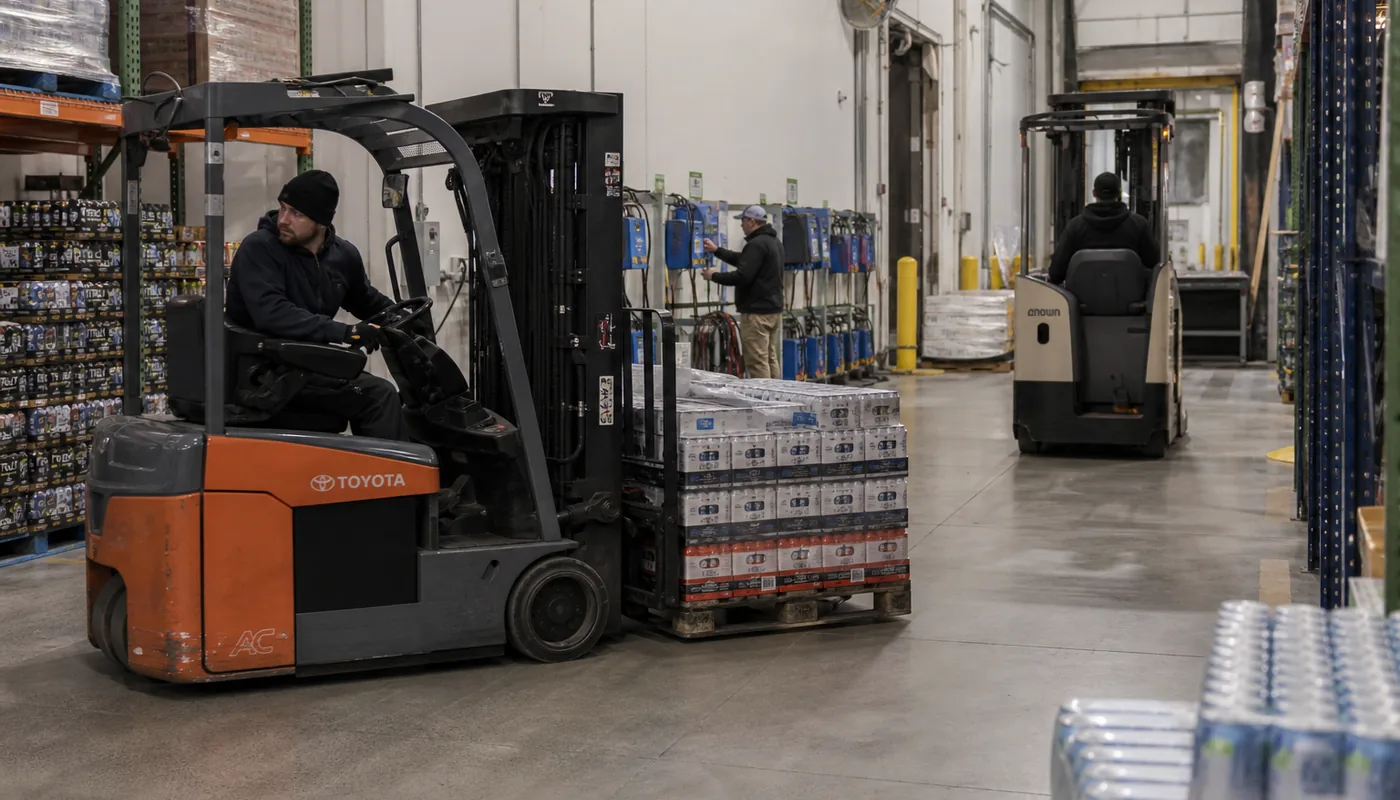
Electric forklifts have moved well beyond light indoor duty. Modern three-wheel and four-wheel counterbalance trucks can cover demanding warehouse work, but the battery and charger must be planned with the same care as the mast and forks. Buyers get into trouble when they compare truck prices and treat the energy system as an accessory.
Review the benefits of electric forklifts, then compare current warehouse forklift inventory by shift coverage and application.
Toyota 8FBCU-series, Crown SC 6000-series, Hyster J50XN/J50XNT families and Yale ERP050-series trucks are common names in warehouse conversations. Three-wheel models favor tight turning; four-wheel configurations generally feel more familiar in longer travel and dock work. Each manufacturer offers multiple mast, battery and control choices, so compare dealer-built configurations rather than brochure headlines.
| Model or category | Good starting application | What to verify |
|---|---|---|
| Toyota 8FBCU family | General indoor warehouse and dock work | Battery compartment, mast, tire and local service configuration |
| Crown SC 6000 family | Warehousing, production and fleet standardization | Operator fit, service access, battery strategy and attachments |
| Hyster J50XN / J50XNT family | Distribution and manufacturing | Three- versus four-wheel layout, shift duty and charger pairing |
| Yale ERP050 family | Indoor material handling and dock operations | Energy package, ergonomics, cooling and dealer support |
A two-shift distributor wants cleaner indoor operation and less cylinder handling. The trucks average six productive hours per shift, but the second shift starts shortly after the first ends. A single lead-acid battery per truck looks economical until watering, cooldown and charging windows are mapped.
Practical takeaway: The buyer compares opportunity-charged lithium configurations with a properly staffed lead-acid battery program, including chargers, electrical work and battery handling. The truck price matters, but the schedule determines whether the fleet is available when orders peak.

Hours on the clock are not the same as traction hours. Travel distance, lifts, ramps, attachments, temperature and operator habits affect energy use.
Voltage, amperage, connector, ventilation, location and utility capacity must be confirmed before delivery.
Lithium can simplify opportunity charging; lead-acid remains practical in many controlled fleets. Compare acquisition, infrastructure, maintenance and replacement assumptions.
A three-wheel truck can turn tightly, but stability, dock work and operator preference may favor a four-wheel configuration. Measure the real aisle and pallet overhang.
Shared batteries, chargers, forks and technician knowledge can reduce fleet complexity, but a single specification should not be forced onto incompatible tasks.
A useful quote should identify the exact model and year, rated capacity at the required lift height and load center, mast and lowered height, tires, power source, attachments, operating hours or battery details, warranty, delivery, setup, training assumptions and the final delivered price. If two proposals do not describe the same machine and support scope, the lower number is not automatically the better buy.
Compare complete electric packages through the forklift quote service, including the truck, battery, charger, freight and support.
They can be, particularly in steady indoor duty, but the result depends on energy, battery life, maintenance, infrastructure, utilization and local costs.
Runtime varies with battery capacity, truck configuration, load, travel, lift cycles, temperature and charging practice. Size from measured duty rather than a universal promise.
No. Lithium is attractive for opportunity charging and reduced routine battery maintenance, while lead-acid can remain economical in disciplined operations with suitable charging time.
Not always. Ask every seller to state exactly what is included and whether the electrical installation is separate.


September 28,2026

September 25,2026

September 22,2026

September 21,2026

September 18,2026
The largest network of forklift dealers in the US and Canada is at your fingertips. Get the best pricing nationwide now on renting or buying a forklift
Get the lowest prices from our forklift dealers near you.
